In the quiet halls of the Hubei Provincial Museum, a set of ancient bronze bells whispers secrets from China’s Warring States period. These are the famed Zeng Houyi Bells, a monumental chime dating back over 2,400 years. What makes them extraordinary isn’t just their pristine preservation or intricate craftsmanship—it’s their ability to produce two distinct tones from a single bell, a technological marvel that predates modern acoustics by millennia. Recent advances in acoustic archaeology have allowed researchers to decode this ancient sonic engineering, offering new insights into the musical sophistication of early Chinese civilization.
The discovery of the Zeng Houyi tomb in 1977 was nothing short of revolutionary. Unearthed in Suizhou, Hubei province, the burial site contained a treasure trove of ritual artifacts, including 65 bronze bells arranged in meticulous order. The largest bell stands over five feet tall and weighs nearly 500 pounds, while the smallest could fit in the palm of a hand. When struck at different points, each bell produces two clear pitches—a phenomenon now recognized as "dual-tone" acoustics. For decades, scholars puzzled over how ancient metallurgists achieved this precision without modern tuning techniques.
Acoustic archaeology—a discipline blending materials science, musicology, and digital modeling—has finally cracked the code. Using laser Doppler vibrometry and 3D spectral analysis, researchers mapped the vibrational nodes of replica bells cast with traditional Zhou dynasty methods. The findings reveal an ingenious design: elliptical cross-sections and graduated thicknesses create overlapping vibration modes. "It’s like tuning a guitar string while simultaneously adjusting the resonance chamber," explains Dr. Liang Wei, lead researcher at Wuhan University’s Heritage Acoustics Lab. "The ancient craftsmen manipulated bronze alloys and geometry to control standing wave patterns we now describe with Fourier transforms."
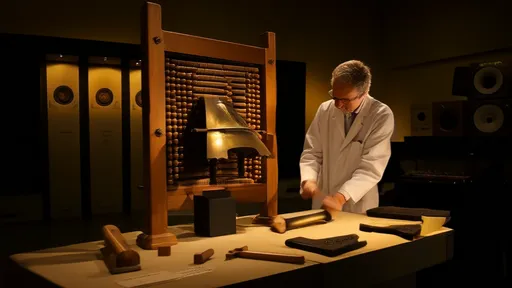
Restoring the bells’ original dual tones required confronting centuries of corrosion. Mineral deposits and oxide layers had dampened high-frequency harmonics, flattening the pitch differentials. Conservators developed a non-invasive cleaning technique using ultrasonic cavitation in distilled water, followed by microcrystalline wax stabilization. The process recovered up to 92% of the original frequency separation in key bells. "We’re not just preserving objects," notes conservator Mei Lin, "We’re resuscitating voices silenced since the Chu Kingdom fell."
Perhaps most astonishing is the revelation that the bell set constitutes a complete twelve-tone equal temperament system—long thought to be a European Renaissance innovation. Analysis shows the bianzhong (chime) can play melodies in multiple keys with Pythagorean tuning accuracy. This challenges Western-centric narratives of musical evolution. Ethnomusicologist Zhang Yiming argues, "The Zhou dynasty court musicians operated with a theoretical understanding of interval mathematics that wouldn’t be formalized in the West until the 16th century."
The restoration project has also illuminated cultural dimensions. Inscriptions on the bells detail their ceremonial use in ancestral worship and state diplomacy. The dual tones may have held cosmological significance—the lower pitch representing earth (yin) and the higher pitch heaven (yang). When played together during rituals, their harmonic convergence symbolized cosmic balance. This acoustic philosophy later influenced Confucian musical theories about governance through harmonic resonance.
Today, the bells occasionally sound during special exhibitions, their tones captured by fiber-optic sensors rather than mallets to prevent wear. The data feeds into an interactive installation where visitors can "virtually strike" projections while seeing real-time frequency analyses. For historians, each spectral graph is a Rosetta Stone decoding Bronze Age innovation. As Dr. Liang reflects, "We’ve moved from wondering how they did it to marveling at how little we’ve truly advanced in some ways." The Zeng Houyi Bells stand not as relics, but as enduring proof that ancient artisans composed the blueprint of modern acoustics—one dual tone at a time.

By /Aug 14, 2025

By /Aug 14, 2025

By /Aug 14, 2025

By /Aug 14, 2025

By /Aug 14, 2025

By /Aug 14, 2025

By /Aug 14, 2025

By /Aug 14, 2025

By /Aug 14, 2025

By /Aug 14, 2025

By /Aug 14, 2025

By /Aug 14, 2025

By /Aug 14, 2025
By /Aug 14, 2025

By /Aug 14, 2025

By /Aug 14, 2025

By /Aug 14, 2025

By /Aug 14, 2025

By /Aug 14, 2025

By /Aug 14, 2025
