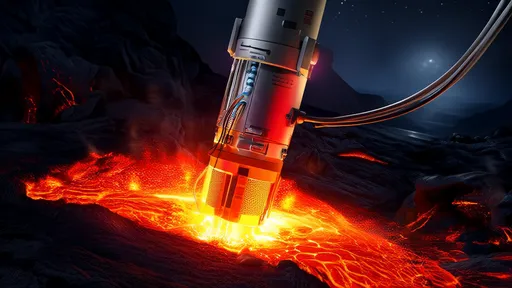
In the relentless pursuit of understanding Earth's most volatile phenomena, volcanologists have made a groundbreaking leap with the deployment of silicon carbide (SiC) sensors in active lava flows. These rugged probes, capable of surviving temperatures exceeding 1,600°C, are transmitting unprecedented real-time data from the heart of molten rock systems. Unlike traditional monitoring methods that rely on surface observations or indirect measurements, these advanced sensors plunge directly into the fiery crucible where most instruments would vaporize within seconds.
The development marks a paradigm shift in how scientists approach volcanic hazard assessment. "We're no longer limited to interpreting volcanic behavior through secondary signals," explains Dr. Elena Torres, lead researcher at the Reykjanes Peninsula deployment site. "For the first time, we're collecting chemical composition readings, viscosity changes, and gas saturation levels from within actively flowing lava tubes—data that previously existed only in theoretical models."
Engineering Marvels in Extreme Environments
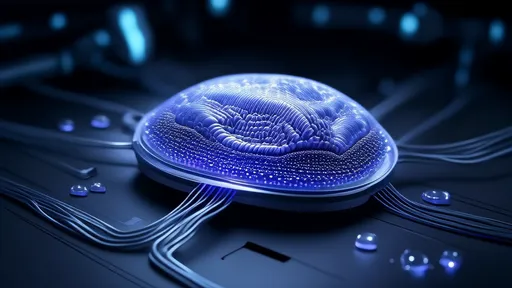
What makes these sensors extraordinary isn't just their heat resistance, but their ability to maintain functionality under conditions that would destroy conventional electronics. The silicon carbide semiconductor components demonstrate remarkable stability, with signal transmission continuing even as the surrounding rock begins to crystallize. Each probe contains multiple sensor arrays protected by boron nitride ceramic housings, with data transmitted via pulsed laser through the lava's surface to nearby receivers.
Field tests in Hawaii's Kīlauea volcano revealed unexpected fluid dynamics within lava channels. "We discovered pulsating flow patterns resembling arterial blood movement, completely changing our understanding of how lava travels," notes Dr. Rajiv Chowdhury of the Hawaiian Volcano Observatory. The sensors detected rhythmic pressure variations corresponding with gas bubble formation—phenomena invisible to surface-mounted instruments.
Unlocking Magma's Chemical Fingerprint
Beyond physical measurements, the probes provide continuous spectroscopic analysis of molten rock. This capability proved crucial during Italy's Mount Etna eruption last spring, when sensors identified an abrupt increase in dissolved carbon dioxide—a potential precursor to explosive activity—nearly 72 hours before traditional monitoring systems detected concerning changes. Civil authorities used this advance warning to implement phased evacuations, demonstrating the technology's lifesaving potential.
The chemical data also settles longstanding debates about magma chamber dynamics. Contrary to the "well-mixed reservoir" theory, silicon carbide sensors revealed complex stratification within lava flows, with distinct chemical layers preserving information about different depths of origin. These findings may explain why some volcanoes transition abruptly between effusive and explosive eruptions.
Challenges and Future Directions
Despite their resilience, the probes aren't indestructible. About 15% fail during deployment when encountering particularly turbulent flows or getting crushed by collapsing lava tube ceilings. Researchers are experimenting with self-righting designs inspired by deep-sea submersibles and adding traceable elements to recover sensors after eruptions for performance analysis.
The next generation of probes will incorporate miniature mass spectrometers to detect rare isotopes that could reveal magma's mantle origins. Another ambitious project aims to create networked arrays where multiple sensors communicate through the lava itself using low-frequency seismic pulses. This would allow three-dimensional mapping of entire magma conduits during eruptions.
As climate change increases volcanic activity in thawing permafrost regions, these technological advances arrive at a critical juncture. The silicon carbide sensors represent more than just sophisticated instrumentation—they're our first true window into the subterranean forces that shape our planet's surface. With continued development, they may one day provide the kind of early warning systems that earthquake monitoring offers, potentially saving thousands of lives in vulnerable communities worldwide.

By /Aug 14, 2025

By /Aug 14, 2025
By /Aug 14, 2025

By /Aug 14, 2025
By /Aug 14, 2025
By /Aug 14, 2025

By /Aug 14, 2025
By /Aug 14, 2025
By /Aug 14, 2025

By /Aug 14, 2025
By /Aug 14, 2025
By /Aug 14, 2025

By /Aug 14, 2025
By /Aug 14, 2025

By /Aug 14, 2025
By /Aug 14, 2025
By /Aug 14, 2025

By /Aug 14, 2025
By /Aug 14, 2025

By /Aug 14, 2025
