The harsh desert environment seems an unlikely place to find sophisticated water collection systems, yet nature has engineered remarkable solutions in the most arid landscapes. Among these biological marvels, the humble cactus stands out with an extraordinary ability to harvest moisture from thin air. Recent scientific investigations into the microstructure of cactus spines reveal a complex mechanism for directional water transport that could revolutionize our approach to water scarcity.
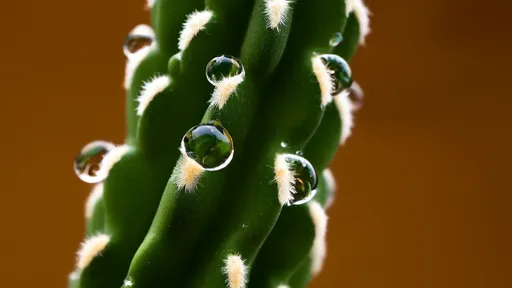
In the vast deserts where rainfall may occur only once every few years, the cactus's survival depends on its ability to extract water from occasional fog or morning dew. The plant's spines, long dismissed as mere defensive structures, actually function as highly efficient microfluidic systems. Researchers have discovered that these needle-like projections possess a unique hierarchical structure that enables them to collect, condense, and channel microscopic water droplets toward the plant's stem with unerring precision.
The secret lies in the spine's gradient structure - a subtle but critical variation in surface properties along its length. At the microscopic level, the base of each spine exhibits greater hydrophilicity (water-attracting properties) compared to the tip. This creates an energy gradient that propels condensed water droplets in one direction only: toward the plant's core where it can be absorbed. The phenomenon represents one of nature's most elegant examples of passive fluid transport.
High-resolution microscopy has revealed even more sophisticated design elements. The spines feature nanoscale grooves that run longitudinally from tip to base, creating capillary channels that enhance water movement. These grooves are not uniform - their depth and spacing vary systematically along the spine's length to optimize droplet coalescence and transport. When fog rolls across the desert, microscopic water droplets first nucleate on the spine's surface, then merge as they're drawn toward the hydrophilic base by surface tension forces.
What makes this system truly remarkable is its directional specificity. Unlike conventional surfaces where condensation forms randomly and drips in arbitrary directions, cactus spines enforce a strict one-way flow. This prevents precious water from being lost to evaporation or falling uselessly to the ground. The entire process occurs without any moving parts or energy input from the plant - a completely passive yet highly reliable mechanism refined through millions of years of evolution.
Engineers and material scientists are now racing to replicate this biological marvel for human applications. Prototype surfaces mimicking cactus spine microstructure have demonstrated impressive water-harvesting capabilities in laboratory tests. These bioinspired materials could lead to self-filling water bottles for desert travelers, fog-collecting nets for arid region agriculture, or even atmospheric water generators for off-grid communities.
One particularly promising application involves integrating spine-like structures into the design of cooling towers and power plant condensers. Traditional systems rely on energy-intensive methods to remove condensed water from heat exchange surfaces. A cactus-inspired approach could dramatically improve efficiency by ensuring condensed water immediately flows away from the surface, maintaining optimal heat transfer conditions.
The potential impact on global water security cannot be overstated. With nearly two billion people living in water-scarce regions, technologies that can extract moisture from air with minimal energy input could transform lives. Unlike conventional desalination or water transportation schemes that require massive infrastructure investments, bioinspired collectors based on cactus spines could be deployed cheaply at small scales where they're needed most.
Beyond practical applications, the study of cactus spines has advanced fundamental knowledge in surface science and microfluidics. Researchers have developed new theoretical models to explain the complex interplay between surface chemistry, topography, and fluid dynamics at microscopic scales. These insights are finding applications in fields as diverse as medical diagnostics (for precise fluid handling in lab-on-a-chip devices) and advanced manufacturing (for controlling deposition of microscopic materials).
As climate change exacerbates drought conditions across many regions, nature's solutions to extreme aridity become increasingly relevant. The cactus spine's water-harvesting mechanism represents just one example of how biomimicry - the practice of learning from and emulating biological strategies - can provide sustainable solutions to human challenges. Other desert organisms, from beetles that collect fog on their backs to plants that store water in specialized tissues, offer additional models worth studying.
Ongoing research aims to improve upon nature's designs by combining biological principles with advanced materials. Scientists are experimenting with spine-like structures made from novel polymers, metamaterials, and hybrid composites that might outperform natural cactus spines in certain respects. Some teams are investigating how to scale up the effect for industrial applications, while others focus on miniaturizing it for microelectronic cooling systems.
The story of cactus spine-inspired water harvesting illustrates how paying close attention to nature's subtle details can yield transformative technologies. What began as curiosity about how desert plants survive has blossomed into a multidisciplinary field with far-reaching implications. As research progresses, we may find that solutions to some of humanity's most pressing challenges have been growing quietly in the desert all along - we simply needed to look closely enough to understand them.
In scientific laboratories from Beijing to Berkeley, the race is on to fully decode and harness this remarkable natural technology. The next decade will likely see cactus-inspired materials move from laboratory prototypes to real-world applications, potentially changing how we think about water collection in arid environments. One thing remains certain: as we face growing environmental challenges, nature's 3.8 billion years of research and development experience will continue to provide invaluable guidance.

By /Aug 14, 2025

By /Aug 14, 2025

By /Aug 14, 2025

By /Aug 14, 2025

By /Aug 14, 2025

By /Aug 14, 2025
By /Aug 14, 2025

By /Aug 14, 2025

By /Aug 14, 2025
By /Aug 14, 2025

By /Aug 14, 2025

By /Aug 14, 2025

By /Aug 14, 2025

By /Aug 14, 2025

By /Aug 14, 2025

By /Aug 14, 2025

By /Aug 14, 2025

By /Aug 14, 2025
By /Aug 14, 2025

By /Aug 14, 2025
