The concept of a vacuum capsule logistics network, coupled with intercity maglev delivery systems, represents a futuristic leap in transportation technology. This innovative approach promises to revolutionize how goods and even people are transported across vast distances with unprecedented speed and efficiency. The idea, once confined to the realms of science fiction, is now inching closer to reality as advancements in magnetic levitation and vacuum tube technologies converge.
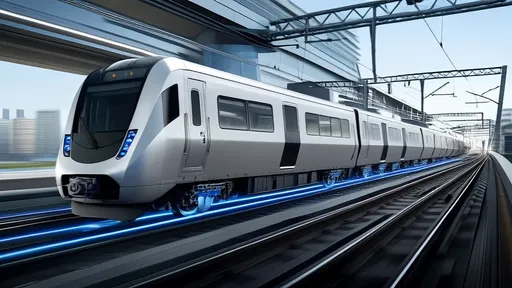
At the heart of this system lies the marriage of two groundbreaking technologies: magnetic levitation (maglev) and hyperloop-inspired vacuum tubes. Maglev trains, already in limited commercial use, rely on powerful electromagnets to suspend and propel vehicles without physical contact with tracks. This eliminates friction, allowing for smoother, quieter, and significantly faster travel. When combined with the near-frictionless environment of a vacuum tube, speeds could theoretically approach or even exceed 1,000 km/h.
The implications for logistics are staggering. Traditional freight transport, constrained by road congestion, weather conditions, and the physical limitations of conventional rail and air systems, could be transformed overnight. A vacuum capsule maglev network would operate independently of surface conditions, unaffected by traffic, storms, or other terrestrial obstacles. Packages could traverse hundreds of kilometers in mere minutes rather than hours or days.
Several key advantages make this system particularly compelling for modern logistics needs. First, the energy efficiency of maglev systems in vacuum environments could dramatically reduce the carbon footprint of freight transport. Without air resistance or rolling friction, the energy required to maintain high speeds is minimal compared to traditional transportation methods. Second, the predictability and reliability of such a system would far surpass current options, with departure and arrival times measured in seconds rather than hours.
The technological challenges, however, remain formidable. Maintaining hundreds of kilometers of vacuum tubes presents engineering hurdles, particularly when accounting for thermal expansion, seismic activity, and maintenance access. The maglev components must be exceptionally reliable, as any failure in the propulsion or levitation systems could bring the entire network to a standstill. Safety systems would need to be redundant and foolproof, capable of handling emergencies at speeds never before encountered in civilian transport systems.
Economic considerations loom equally large. The infrastructure costs for such a network would be astronomical, likely requiring unprecedented public-private partnerships. Right-of-way acquisition, particularly in densely populated urban corridors, could prove politically and financially challenging. Yet, proponents argue that the long-term benefits - reduced highway congestion, lower emissions, and near-instantaneous delivery capabilities - could justify the massive upfront investment.
Pilot projects around the world are beginning to test the viability of various components of this vision. In some countries, short-distance maglev freight systems are already operational, handling high-value, time-sensitive cargo between specific industrial hubs. Experimental vacuum tube segments have demonstrated the technical feasibility of maintaining low-pressure environments over meaningful distances. The next decade will likely see these technologies gradually converge into functional prototypes of intercity vacuum maglev delivery networks.
The potential applications extend far beyond package delivery. Medical transport could be revolutionized, with organs or critical medications shuttled between cities in minutes rather than hours. High-value manufacturing components could move between facilities with clockwork precision. Some visionaries even speculate about scaled-up versions capable of transporting passengers at speeds that would make cross-continental commuting feasible.
As with any transformative technology, regulatory frameworks lag behind the engineering possibilities. New standards would need to be developed for everything from capsule design to emergency protocols. International cooperation would be essential for cross-border systems, requiring harmonization of safety and operational standards across jurisdictions. The legal implications of near-supersonic freight transport have barely begun to be explored by policymakers.
The societal impact could be profound. Just as the interstate highway system reshaped economic geography in the 20th century, a continental vacuum maglev network could redefine concepts of distance and accessibility. Regional economies might integrate more tightly as the friction of distance diminishes. Inventory management philosophies could shift dramatically when next-hour delivery becomes feasible across hundreds of kilometers.
Critics raise valid concerns about the concentration of such infrastructure in wealthy corridors, potentially exacerbating regional inequalities. There are also questions about the cybersecurity implications of highly automated, interconnected transport networks vulnerable to digital threats. The environmental impact of constructing extensive underground or elevated tube networks warrants careful study, despite the clean operation of the completed system.
Looking ahead, the vacuum capsule maglev network represents more than just a new way to move packages. It embodies a fundamental rethinking of spatial relationships in an increasingly connected world. As urbanization intensifies and e-commerce continues its relentless growth, the pressure for faster, cleaner, and more reliable logistics solutions will only increase. While significant hurdles remain, the convergence of technologies suggests that what seems like science fiction today may become operational reality within a generation.
The coming years will be crucial for determining whether this vision can transition from prototype to practical infrastructure. Success will require not just technological breakthroughs but also unprecedented collaboration between engineers, entrepreneurs, policymakers, and the public. One thing is certain: the future of logistics has never looked more exciting, or more transformative, than it does through the lens of vacuum capsule maglev networks.
By /Aug 14, 2025

By /Aug 14, 2025

By /Aug 14, 2025

By /Aug 14, 2025
By /Aug 14, 2025

By /Aug 14, 2025

By /Aug 14, 2025
By /Aug 14, 2025
By /Aug 14, 2025

By /Aug 14, 2025

By /Aug 14, 2025

By /Aug 14, 2025

By /Aug 14, 2025

By /Aug 14, 2025

By /Aug 14, 2025

By /Aug 14, 2025

By /Aug 14, 2025

By /Aug 14, 2025

By /Aug 14, 2025

By /Aug 14, 2025
