The discovery of amino acids in meteorites has long fascinated scientists studying the origins of life. These organic molecules, the building blocks of proteins, exhibit a curious asymmetry known as chirality—a property that could hold the key to understanding how life emerged on Earth. Recent research suggests that the preference for left-handed amino acids in terrestrial life may not be a random occurrence but rather a bias imprinted by extraterrestrial influences.
Chirality refers to the handedness of molecules, much like how left and right hands are mirror images but cannot be superimposed. In living organisms on Earth, amino acids are almost exclusively left-handed, while sugars in DNA and RNA are right-handed. This uniformity is puzzling because, in abiotic conditions, both left and right-handed forms are produced in equal amounts. The question then arises: why did life favor one hand over the other?
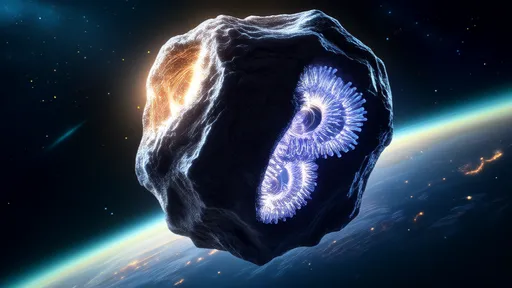
Meteorites, particularly carbonaceous chondrites, have provided compelling clues. Analyses of these space rocks reveal an excess of left-handed amino acids, suggesting that the bias may have originated in space. One leading hypothesis is that polarized light from neutron stars or other cosmic sources could have selectively destroyed one enantiomer over the other, creating an imbalance. Alternatively, processes occurring on the surfaces of interstellar dust grains might have favored the formation of one chiral form.
The implications of this discovery are profound. If the preference for left-handed amino acids was indeed seeded by meteoritic delivery, it would mean that the very foundations of life on Earth were influenced by extraterrestrial chemistry. This idea challenges the notion that life’s asymmetry emerged purely through terrestrial processes, such as crystallization or enzymatic reactions. Instead, it points to a cosmic bias—a subtle but decisive nudge from the universe itself.
Further supporting this theory is the detection of amino acids in the Murchison meteorite, which fell in Australia in 1969. Studies of its composition revealed a slight but significant excess of left-handed amino acids, mirroring the pattern seen in terrestrial life. Similar findings in other meteorites strengthen the case for an extraterrestrial origin of life’s chiral preference. These meteorites are thought to date back to the early solar system, implying that the bias existed before life even began on Earth.
Laboratory experiments have also shed light on how such chiral imbalances could arise in space. When simulating the conditions of interstellar ice exposed to ultraviolet light, researchers observed the formation of amino acids with a slight enantiomeric excess. This suggests that photochemical reactions in space could be a plausible mechanism for generating the observed bias. The fact that these conditions are widespread in the cosmos raises the possibility that life elsewhere might also exhibit similar chiral preferences.
Critics of the extraterrestrial chirality hypothesis argue that the excess of left-handed amino acids in meteorites is too small to account for the near-uniformity seen in life. They propose that amplification mechanisms on Earth, such as autocatalytic reactions or self-replicating systems, could have magnified a minor initial bias. However, even if terrestrial processes played a role, the presence of chiral amino acids in meteorites suggests that the starting material was not entirely racemic.
The search for answers continues with missions like NASA’s OSIRIS-REx, which returned samples from the asteroid Bennu in 2023. Analyzing these pristine materials could provide further evidence of chiral biases in space. Similarly, the study of comets and interstellar particles may offer new insights into how universal this phenomenon truly is. If chiral excesses are common in the cosmos, it would bolster the idea that life’s handedness is not a terrestrial fluke but a cosmic imperative.
Beyond its implications for the origins of life, the study of amino acid chirality in meteorites has practical applications. Understanding how chiral molecules behave in space could inform the design of pharmaceuticals, where the wrong-handed version of a drug can be ineffective or even harmful. It also raises philosophical questions about whether life elsewhere would follow the same biochemical rules or if alternative chiralities could give rise to entirely different forms of biology.
As research progresses, the story of life’s origins grows increasingly intertwined with the chemistry of the cosmos. The discovery of amino acids in meteorites and their chiral bias offers a tantalizing glimpse into how the universe may have set the stage for life. Whether this bias was a decisive factor or merely a contributing one remains to be seen, but the evidence suggests that the building blocks of life—and perhaps life itself—are far more connected to the stars than we once imagined.

By /Aug 14, 2025

By /Aug 14, 2025

By /Aug 14, 2025

By /Aug 14, 2025

By /Aug 14, 2025
By /Aug 14, 2025
By /Aug 14, 2025

By /Aug 14, 2025

By /Aug 14, 2025
By /Aug 14, 2025
By /Aug 14, 2025
By /Aug 14, 2025
By /Aug 14, 2025
By /Aug 14, 2025

By /Aug 14, 2025
By /Aug 14, 2025
By /Aug 14, 2025

By /Aug 14, 2025
By /Aug 14, 2025
By /Aug 14, 2025
